
Chapter 1

Does God Exist?
-
Does God exist?
I’m not sure the question is much on people’s minds these days. The “new atheists” have faded from view, and so have their arguments against religion in general and Christianity in particular.
The problem might not be the cultural influence of atheism but our general indifference to religion, even if we claim to be religious! Sometimes God gets crowded out by the cares and concerns of ordinary life. We don’t doubt or struggle as much as we get distracted. We neglect God more than reject God, though the results often turn out to be quite similar. We have other things to think about, and slowly push God to the side until God seems to disappear from view.
But then something happens—a diagnosis of cancer, the death of a child, spouse, or close friend, the breakup of a marriage, a debilitating pathology, financial difficulty, or just a hard life—that suddenly awakens need for and interest in God. But the very crisis that propels us to think about God makes us wonder if God is there to help us. After all, why would the crisis have occurred in the first place if God was doing what we think God is supposed to do, which is to make life better for us? If God does exist, can we even trust God?
In the end, therefore, I think the question is still important. Sooner or later it worms its way to the surface of life and forces us to take it on.
Continue reading in The Christian Faith as a Way of Life
Spiritual Formation
-
Psalm 13, 16, 27, 36, 73, 103, 139, 146
Characters who appear in the biblical story claimed to know God. They sometimes wrote about their experience of God. One collection of writings, known as Psalms, offer more poetic reflections on those experiences. What do you learn from these reflections? What themes come through? What do you learn about God and about what it might mean to know God?
-
Let’s begin with questions rather than answers. What are the big questions of life that people always ask, sooner or later? That you might be asking, too. Make a list of them. Which ones are especially relevant and important to you right now? Is it a question about suffering? About purpose? About decision-making? About the meaning of life? About the unfairness of life? About the utter mystery of life? Why you exist at all? How would you answer these questions if God exists? How would you answer them if God doesn’t exist? Give yourself time to ponder these questions. In short, imagine a world without God. And then imagine a world with God. Which does a better job of answering your questions?
-
Always begin and end your sessions in prayer. Pray the material into your lives. Aim for transformation. Spend time exploring what you learned from chapter 1, the Bible study, and the spiritual exercise. Listen attentively to each other. Ask each other questions. Strive for understanding. Apply to life.
-
You make known to me the path of life;
you will fill me with joy in your presence,
with eternal pleasures at your right hand.Psalm 16:11
Resources from the History of the Church
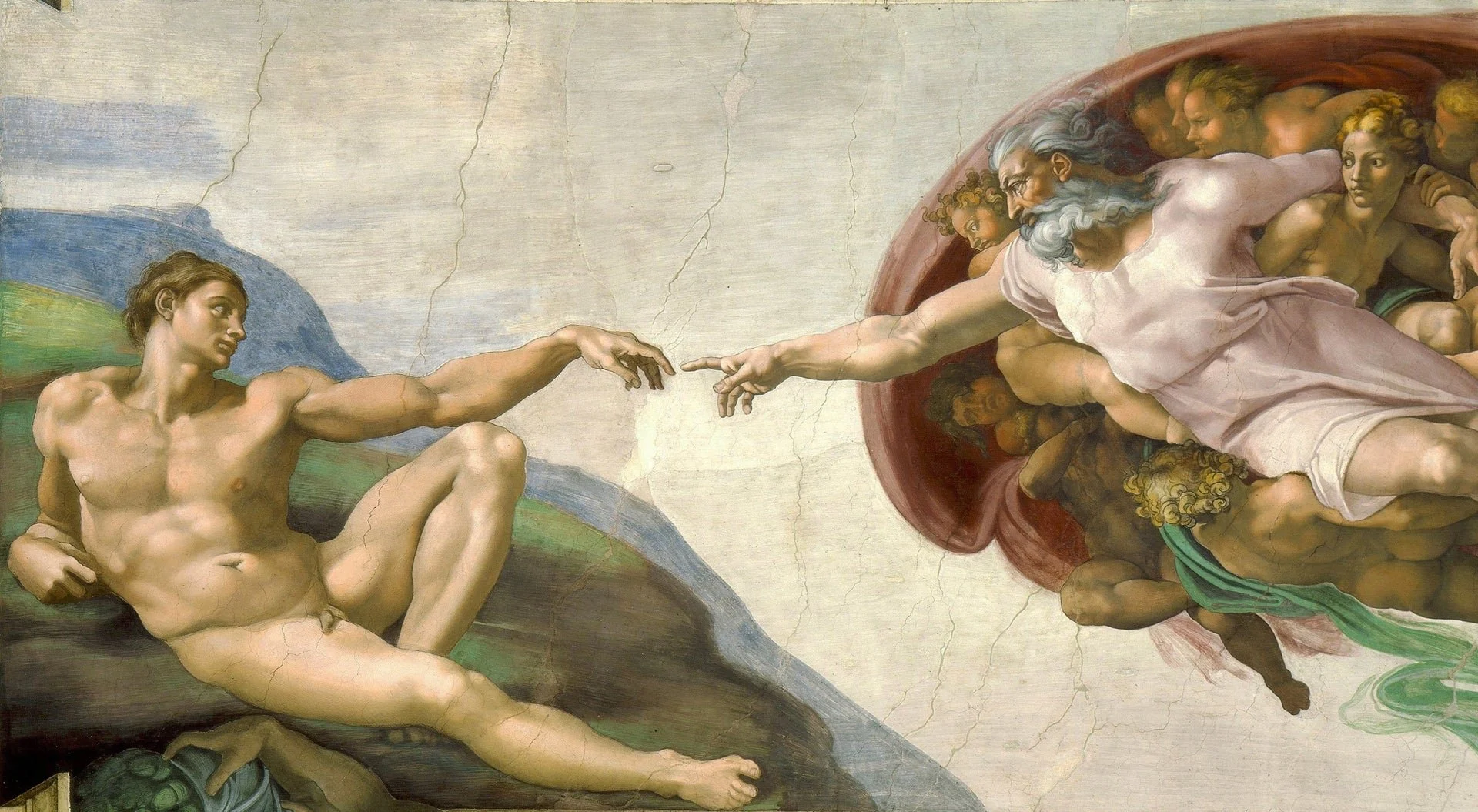
The Creation of Adam (1508–1512), by Michelangelo. Fresco in the Sistine Chapel, Vatican City.
Image source: Kuurth, "The Creation of Adam Meaning."
Prayers
For Taking Pleasure in God's Creation
O Lord, you who are the Creator of heaven and earth, may we take pleasure in your creation this day as you take pleasure in it, we pray, and may we live this day as a people who have been crowned with glory, so that all we do may be done in praise of you and in anticipation of that day when the whole world shall be made fully and forever alive. We pray this in the name of the One who makes heaven and earth for love's sake. Amen.
W. David O. Taylor
You . . . and therefore us
The day demands that we begin in praise of you,
for the day is yours and we are yours;
we could not live the day without reference to you,
without your gifts,
without your commands.
We begin with praise,
for the gift of life,
for the gift of our life together,
for the gift of life in your world
with all your beloved creatures,
for the gift of life in your church
with your steady recital of wonders.
You, you alone, only you,
you who made and makes and remakes heaven and earth,
you who executes justice and gives food we know not how,
you who sets prisoners free and sights the blind,
you who lifts up and watches and upholds,
you who reigns forever,
you . . . and therefore us.
You, except we turn to lesser trusts,
all of us with our trust in the powers,
You, except we turn to ignoble aims,
all of us preoccupied with ourselves.
You, except we invest in our little controls and our larger fears,
all of us marked by anxiety.
And then we watch as you ease us out of anxiety,
as you heal our selves turned new,
as you topple powers and bring new chances
for truthful public life.
You . . . except . . . but then finally, always, everywhere you . . .
and us on the receiving end.
And we are grateful. Amen.
On reading Psalm 146, the day Milosovich fell in Belgrade,
Campbell Seminar / October 16, 2000
Hymns
O Worship the King All Glorious Above
O worship the King all-glorious above,
O gratefully sing his power and his love:
our shield and defender, the Ancient of Days,
pavilioned in splendor and girded with praise.
O tell of his might and sing of his grace,
whose robe is the light, whose canopy space.
His chariots of wrath the deep thunderclouds form,
and dark is his path on the wings of the storm.
Your bountiful care, what tongue can recite?
It breathes in the air, it shines in the light;
it streams from the hulls, it descends to the plain,
and sweetly distills in the dew and the rain.
Frail children of dust, and feeble as frail,
in you do we trust, nor find you to fail.
Your mercies, how tender, how firm to the end,
our Maker, Defender, Redeemer, and Friend!
O measureless Might, unchangeable Love,
whom angels delight to worship above!
Your ransomed creation, with glory ablaze,
in true adoration shall sing to your praise!
Written by Robert Grant (1833)
Of the Father’s Love Begotten
Of the Father’s love begotten,
Ere the worlds began to be,
He is the Alpha and Omega,
He is the source, the ending He,
Of the things that are and have been,
And that future years shall see,
Evermore and evermore.
This is He whom they in old time,
Chanted of with one accord,
Whom the voices of the prophets
Promised in their faithful word;
Now He shines, the long-expected;
Let creation praise its Lord,
Evermore and evermore.
O ye heights of heav’n, adore Him;
Angel hosts, His praises sing;
All dominions, bow before Him,
And extol our Lord and King.
Let no tongue on earth be silent,
Every voice in concert ring,
Evermore and evermore.
Christ, to Thee, with God the Father,
And, with Holy Ghost, to Thee,
Hymn and chant and high thanksgiving,
And unwearied praises be;
Honor, glory, and dominion,
And eternal victory,
Evermore and evermore.
Written by Aurelius Prudentius (400)
Translated by John Mason (1852) and Henry Williams Baker (1859)