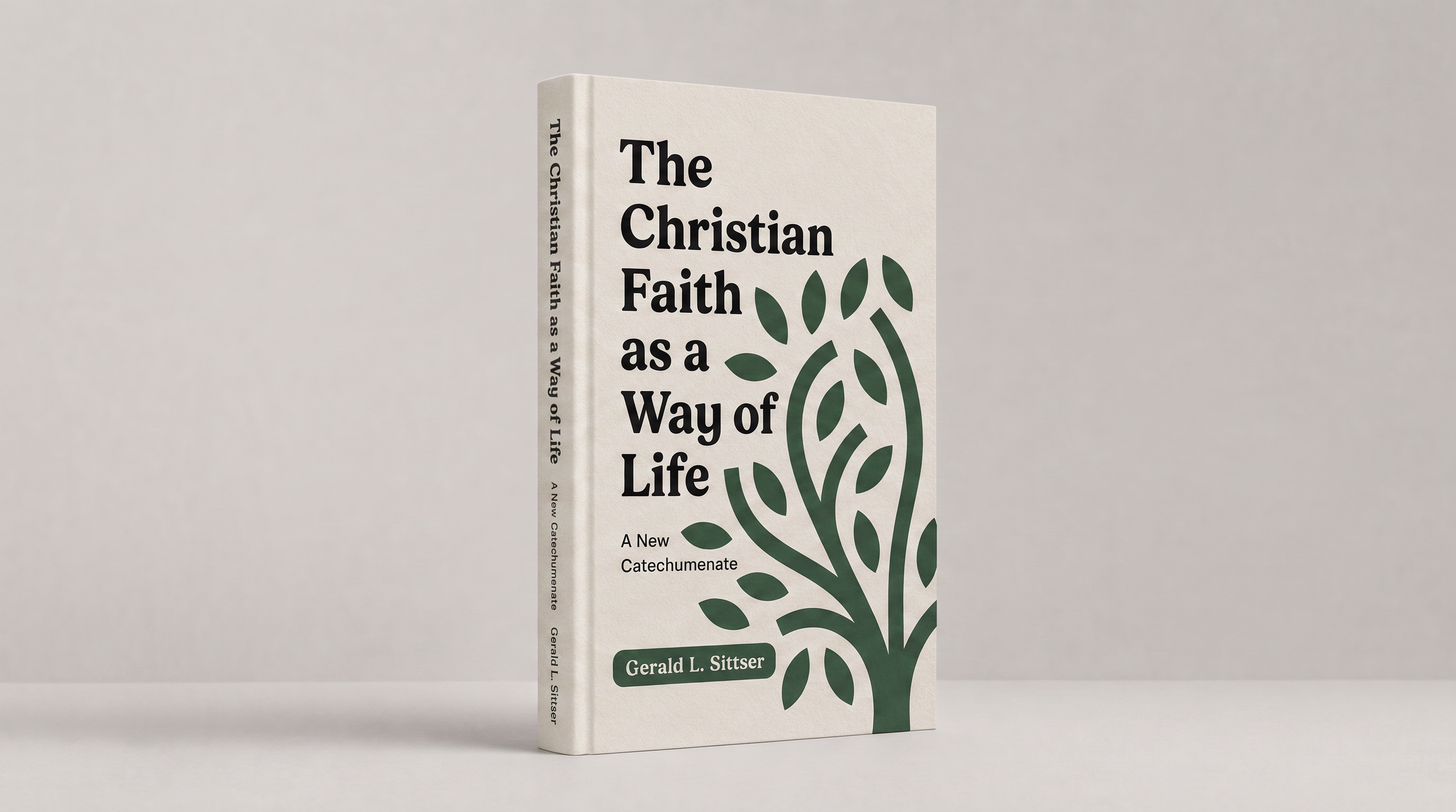
The Christian Faith as a Way of Life
A New Catechumenate
You are about to embark on a journey of learning, discovery, and practice that will expose you to what Christians first developed centuries ago, when the Christian movement was small and marginal, surrounded by a massive culture—the Roman Empire—that did not look favorably upon it. That same movement, however, exercising patience and persistence, kept growing, eventually winning the very empire that had opposed it.
I believe that the church needs a process that is as vigorous, rigorous, and grace-filled as the first process, known as the catechumenate, was. Hence this experiment. Thank you for your interest. I welcome you.
-
This is a book about human transformation. You will learn along the way that such transformation will actually enable you to discover and return to your true self. The word “return,” of course, implies that there is an original you that you somehow lost along the way. It implies you don’t need to reinvent yourself; you just need to find yourself, your essential self, the self God sees, knows, and loves, the self God created and redeemed you to be.
You and I—every human being on this planet—has the stamp of God’s image imprinted on them, as if it were a faint memory hidden deep inside our spiritual DNA. That image has been damaged and effaced, as I’m sure you’ve observed and experienced firsthand in your life and in the lives of the people around you. I certainly have. We have become strangers to ourselves. We are fallen, lost, and broken people. But fallen implies that we can be lifted up, lost that we can be found, broken that we can be repaired, as the story of the Prodigal Son illustrates so well.
God has set in motion a plan to restore, renew, and perfect that image. This transformation is yours for the taking—or better put, yours for the claiming, believing, and living. It will turn you into a person you could never have imagined becoming or achieving on your own. Of course this book can’t do it for you. Only God can transform you. But it will explain how such transformation happens. From beginning to end it is God’s gift to you, though it will also demand everything of you too. It is a paradox, one of many in the Christian faith, as you will see.
Why This Strange Word: Catechumentate?
I will be exploring the process of transformation throughout the book. But first an explanation of the peculiar and unfamiliar word that appears in the subtitle: catechumenate.
The word is probably new to you. It was to me as well, until some 20 years ago. I first happened upon it while doing research for a book on the history of Christian spirituality, published under the title Water from a Deep Well. After writing it I turned my attention to exploring this new word (to me), which resulted in another book, this one on early Christianity, published under the title Resilient Faith. I learned along the way that, while new to me, the term is far from new, dating back to the early Christian movement.
What is the Catechumenate?
It refers to the training process that early Christian leaders developed in the second century, which helped transition seekers from traditional Roman religion, often known as paganism, into the Christian fold. This training process involved an official enrollment; spiritual apprenticeship under a mentor (back then called a “sponsor), with whom the seeker (or catechumen) did life; a curriculum to study and master, which included the Christian story, basic Christian belief, and practical Christian living; and a pathway to follow, known as the way of Jesus. The entire process was bathed in grace, for seekers and converts learned that, from beginning to end, they were a new creation in Christ. The purpose of the catechumenate was to learn to live that out.
Why Then?
The story of how this training process first emerged can be traced back to the earliest period of Christianity.
The Christian movement was birthed in the city of Jerusalem some 2,000 years ago. It centered on an unusual rabbi who attracted huge crowds, taught the true meaning of the ancient faith of Judaism, worked miracles, and attracted a small group of Jewish disciples. In the end, however, most everyone denied knowing him or turned against him, including his closest friends. Jewish authorities called for his death and Roman officials crucified him.
The death of Jesus would have put an end to the movement then and there and his very name forgotten within a generation or two after his death. But the resurrection changed everything. It set a trajectory that turned Christianity into a world religion.
But not immediately, and not easily. The first disciples were all Jews. They carried their Jewish beliefs, disciplines, and customs into Christianity, and thus continued to practice circumcision, eat kosher, frequent the synagogue, study under a rabbi, observe the Sabbath, follow certain dress codes, and obey other laws that established a clear and strict boundary between them and everyone else.
The movement, however, did not—and could not—stay confined within Judaism for very long. The Good News turned out to be better news than even Jewish Christians realized. Samaritans converted to Jesus, and then Gentiles. The movement began to spread into the Roman world, especially through the work of the apostle Paul and his companions.
That steady growth forced them to answer a very big question. Should the movement require Gentiles to become cultural Jews first before becoming Christians? It made some sense. Rome was adept at absorbing new religions into its massive and dominant culture, eventually Romanizing and domesticating those religions. Judaism was a notable exception. It had survived under Roman rule, and not simply Roman but Babylonian, Persian, and Greek. It was an incredibly resilient and resourceful faith. It excelled in establishing clear boundaries that made a sharp distinction between Judaism and the surrounding culture. Would the Christian movement be able to survive without drawing those same strict religious boundaries?
At the Council of Jerusalem, which met in AD 50 or 51 (Acts 15), the leaders of the Christian movement decided it could in fact survive without requiring a double conversion. A conversion to Jesus Christ, the Son of God, was both necessary and enough, and not an additional conversion to a Jewish way of life. It was enough because Jesus was God’s final revelation, savior and Lord. It was Jesus who commanded his followers to “go” and “make disciples” of all nations.
That one decision cut the movement loose to cross cultural barriers with greater ease and creativity. Evangelists, church planters, and ordinary Christians learned how to immerse in different cultures without accommodating to them or isolating from them, which enabled them to grow the movement. Within several generations it was operating in multiple languages and cultures, though it remained essentially the same recognizable faith and way of life across those cultures.
How did early Christians accomplish such a feat?
Early leaders committed themselves to cultivating disciples. The church aimed at transformation, which included not only a conversion to Jesus as savior and Lord but also empowerment through the Holy Spirit, participation in a church, the practice of spiritual discipline, and a radical commitment to service and sacrifice. The church strived to form people in the faith, thus enabling them to trust in and follow the true King and live for his kingdom, which, though not of this world, had everything to do with this world.
The enormity of the task required the creation of a long and sturdy bridge to span the gap between Greco-Roman culture and Christianity. The gap—really, chasm—was simply too wide to assume that crossing from the old world of traditional Roman religion to the new world of Christianity would happen easily, quickly, and naturally. The world of pagan Rome was simply too different from the world of the Christian church.
The catechumenate functioned like a spiritual apprenticeship program. In it new converts—called catechumens—learned about the Christian story; they also learned how to understand their own story in light of it. They learned about the triune nature of God; they also learned how to worship God. They learned about salvation; they also learned how to live as saved people. They learned about prayer; they also learned how to pray. They learned about the needs of others; they also learned how to serve others. They learned about the challenges of living in a pagan culture; they also learned how to witness to that culture. They learned, they practiced, and they applied it to their own cultural context, thus functioning as salt, leaven, and light.
The Christian faith became a way of life for them.
Why Now?
The catechumenate helped grow the church in an empire that was sometimes curious, sometimes suspicious, and sometimes hostile, but rarely friendly to Christianity, except among an increasingly large number of ordinary people. The movement grew slowly and made steady progress. The church comprised roughly 5,000 members in the year AD 40 and roughly five million in the year 300. It was uphill work. Roman culture didn’t make it easy, which is why the movement became strong, like playing in a league with an abundance of competitive teams. Just so did the movement prosper, albeit in fits and starts, through growth spurts and setbacks, with many successes and failures along the way.
Ironically, its success undermined its independence and integrity. Rome finally accepted it. Christianity became a legal religion in the early 4th century and the official religion by the end of the century. The catechumenate slowly declined. It no longer seemed necessary once Christianity grew in popularity and power, eventually emerging as the majority religion.
Cultural Christianity gradually became the norm. People were Christian by default. Christianity was the air they breathed. It was almost impossible not to be Christian. This era of Christendom, as we call it, lasted for centuries. As late as the 1950s, the vast majority of Americans—over 90%—still self-identified as Christian. We can safely assume, however, that many were cultural Christians who believed in Christianity largely because they were born and raised in America, a “Christian nation,” or in Christian Europe.
Such is no longer the case. The West is gradually secularizing, and Christianity is slowly losing its status as the favored religion. We’re no longer breathing the air of Christendom. What once seemed entirely plausible as a worldview has become increasingly implausible, what once felt familiar and comfortable to people has become increasingly alien to them. Christianity now faces fierce competition, which tempts Christians to accommodate to culture in order to maintain their cultural relevance, privilege, and influence, though at the expense of faithfulness, or to separate from culture in order to preserve purity, though at the expense of mission.
But competition is not always bad. It can spell opportunity. It can remind us of what we have lost, like a declining city that rediscovers its vibrant past and aspires to reclaim it. It can renew us in our commitment to Christianity as a belief system and way of life. It can challenge us to rediscover and restore the process that enabled Christianity to survive—and even thrive—in a hostile environment. It can drive our root system deeper, which will only enable us to bear more fruit.
Hence the reason for this “new catechumenate,” which is little more than the old model adapted to a new set of circumstances. As with the old model, it involves more than learning conventional knowledge, though never less. No wonder early Christian writers used athletics as their favorite metaphor. Athletes don’t learn a sport in a classroom, at least not entirely. They learn how to play the sport. The same is true for musicians, surgeons, craftspersons, and farmers. None learns exclusively through reading books and sitting in a classroom. They are trained, not simply taught.
The same should also be true for Christians.
Why Does It Matter?
I believe that we have much to learn from early Christians, which is why I have undertaken to pursue this project. It is not a course on basic Christianity, nor is it a program to teach spiritual discipline, nor is it a plan of action to reform society. It is an exploration of what it means to believe in the Christian faith and to live the Christian way of life. Hence the title—The Christian Faith as a Way of Life.
I cannot emphasize enough that this is a book to be used, not simply read. It might read like a book. But it is not intended to function exclusively as a book. Acquiring more knowledge is not really the point, not completely anyway. You will gain knowledge, but also know-how; you will learn to think, but also to do; you will grow in faith, but also in obedience; you will learn about historic Christianity, but also how Christians have followed the way of Jesus over the centuries. Transformation is the goal, not only transformation as an individual but also transformation as a community.
You will observe, therefore, that at the end of every chapter there is a section called “Spiritual Formation” that will assist you in applying what you read to your life. You will find the Spiritual Formation information on my website—jerrysittser.com. Thus book and website will work hand in hand to guide you through the catechumenate.
I desperately long for such transformation in my own life and in the life of my church. I assume you do too. The entire world is crying out for it, no matter what our immediate circumstances happen to be: young or old, single or married, poor or rich, republican or democrat, American or Kenyan, and so much more. Christianity is truly believable. I will do my best to prove that. It is also supremely livable. If a person wants to learn how to sail, that person can only learn so much on land; eventually he or she must get into a boat and launch into the water.
Jesus himself made this abundantly—and sometimes uncomfortably—clear. On the one hand, he announced that he is “the way, the truth, and the life.” He proclaimed, “No one comes to the Father except through me.” He summoned his disciples to believe in him. On the other hand, he commanded that his disciples follow and imitate him too. Jesus is the way to true life, and Jesus is also the true way of life. He is savior and Lord, God in human flesh. He is also the true human, and thus the supreme example to follow. He makes us new; he also shows us how to live that way.
Like the original catechumenate, this process will take time. The best way to learn and master something is to follow a steady course over a long period of time. It will require patience and persistence. But God is patient and persistent too, far more than we will ever be. God loves us; God loves YOU. In the Christian faith, we always start from the finish line. We become a new creation, made so through the work of Jesus Christ. We then grow into that identity over time. As Paul writes, “Not that I have already obtained this or have already reached the goal, but I press on to lay hold of that for which Christ has laid hold of me” (Phil. 3:12). That is the source of our identity, confidence, and security; that is also our call to action.
-
I will admit that launching such a demanding training process in a church would cause the most ambitious and zealous pastor to pause, wonder, and ask: “Is this endeavor realistic? I have trouble persuading most members of my church to show up twice a month for worship or commit to a program that runs no longer than a month!”
It does seem unrealistic, and even ridiculous.
Still, I chose to develop this process for two reasons. First, because the early Christian movement developed it first—and for good reason, as I have already explained. They were living in a pre-Christendom setting, which required them to develop a long on-ramp for Gentiles who wanted to become followers of Jesus. Circumstances forced them to it. Without the catechumenate, the Christian movement would have failed to survive, thrive, and grow—eventually winning the Roman world, to say nothing about expanding far beyond that world. Second, because we have gradually, and perhaps imperceptibly, entered into a post-Christendom phase of western history. I say imperceptibly because Americans in particular—and even Europeans in general—still think of western culture as Christian, though much of its Christianity has become diluted, compromised, or indifferent.
That dilution, compromise, and indifference has been subtle, and also understandable. Christians have enjoyed cultural privilege and influence for a very long time in western history. The loss of that power has been difficult to accept. Some Christians have panicked and turned aggressive, thinking that they can bully themselves back into power. Others have tried to ride the coattails of a movement that promises to secure or maintain Christianity’s relevance. The early Christian movement can teach us about resilience, patience, resourcefulness, and faithfulness. It might be time for us to start building from the ground up. I believe Isaiah 58:9-12 is the text of the hour. It has certainly become that for me.
My hope and aim is to encourage and help churches to develop a culture of discipleship, and thus avoid creating an insider’s group of “true” Christians, just another program that turns too churchy, or a process that trends in the direction of pharisaic “legalism” rather than Christian freedom. Maturity does not look like a warrior ready to shed blood in the arena; it looks more like the heart of a humble and courageous Christian ready to die in the arena. The young Perpetua, who suffered public martyrdom around the year AD 200, is our model, not some Roman gladiator. It is the martyr that conquered the Roman world, not the warrior. Ironically, martyrs actually demonstrated that they were in fact the true warriors, though of a very different kind.
Churches do become cultures (for example, welcoming, or consumeristic, or stagnant, or creative, or programmatic) so subtly and pervasively that the majority of people don’t even notice. It becomes as familiar and comfortable as a favorite food.
A culture can quickly take on the quality of an entrenched habit, inflexible and unreflective. But cultures can also change, and the best kind of change is slow change. It is like a school, business, sports team, or musical ensemble that transitions from unruly, accusatory, uncommitted, and indifferent to supportive, enjoyable, disciplined, and high-achieving without at the same time becoming legalistic and rigid. It usually begins with a few and bleeds out from there. It can take several years. But it is possible.
This is my aim. I have no visions of grandeur. The church needs something like this tool, but not necessarily this tool—the book you hold in your hand. Even then, this book does not promise instant results. It can’t do everything; it might not do anything. What it promises to do, by the grace and power of God, is basic and unsensational, oriented more toward meeting real needs than felt needs. It is intended to build from the ground up. Veteran members might even consider it insulting because they assume it is starting too far back. “It is for those people, but not for me.”
Still, as Paul wrote, “To write the same things to you is not troublesome to me, and for you it is a source of steadfastness” (Phil. 3:1). Repetition is a good thing, as most people in sports, music, and skilled professions will say. It reinforces a foundation of knowledge and technique that should never be neglected or taken for granted. In the early Christian period the “sponsors” (mentors) of catechumens would go through the basic training of the catechumenate multiple times.
I thank you for your interest. I pray that God guide you to nurture your church to maturity of faith. God calls you to build up the body and equip believers for ministry (Ephesians 4:11-16). Over time this effort under the guidance of the Bible and in the power of the Holy Spirit might set off a chain reaction resulting in a healthy community of people who become functional disciples in a world that desperately needs it.
-
The Commitment
What will be required of you beyond reading? Note that the formational material of this book will be on my website (jerrysittser.com). There you will find the Bible studies, the exercises, the small group questions, and the biblical passages to memorize. As I have already stated, I urge you to use this book and not simply read it.
Practice. None of us would entrust our body to a surgeon who had acquired textbook knowledge of shoulder surgery but had never watched or performed such a surgery—many times over. In most professions some kind of apprenticeship is necessary. Christians are apprentices to Jesus, and will be for a lifetime. Practice is necessary.
Relationships. Christianity is a team sport. Small groups in most churches tend to fizzle because members think the purpose is the small group. It isn’t. Discipleship is the purpose, which both requires community and enriches community. The new catechumenate is designed as a resource for small groups within a local church or a similar setting.
Leadership, not because leaders are more mature than everyone else but because they aspire to become mature and want to help others progress toward the same goal.
Fortitude. During the early Christian period leaders faced the difficulty of growing a movement in a hostile pagan culture. Surprisingly, Christians never tried to compete against Roman religion, at least not directly, playing the same religious game that Rome did. We find no evidence in the first few centuries of huge churches that dotted cityscapes or Christian feasts and festivals that spilled over into public spaces, like the Roman Forum, or laws that Christians imposed on the general population, or slogans and memes that Christians introduced in popular culture, or brand pastors who spent time as spiritual advisors to the emperor. Instead, Christians tried to make disciples.
How should you begin this process?
First, select a group of participants. It could be the church staff, the board of elders, an adult class, youth leaders, one or more small groups. Whoever gets involved will need to know very clearly why you are using this process and what it will require of them.
Second, the group should meet every week, if at all possible, and make its way through the book and its formational process, taking at least two weeks for each chapter, or more. The first week should focus on the content of the chapter and on the Bible study, the second week again on the Bible study and on the exercises. Slow and steady should be the rule. Don’t hesitate to take breaks, too, perhaps after the group completes each of the five major sections.
Third, leaders should see that the group stays on task. Groups naturally digress or wander off topic. Good leaders call them back to the original purpose so that digressions don’t become distractions, detours, and eventually dead-ends.
Finally, the purpose should remain clear. This process is intended to help make disciples. A believable faith should lead to a livable faith, and vice versa.
The Christian faith is a way of life. It was never meant to be less or other than that. This new catechumenate will set you on your way. There is no magic in it. There are other resources available besides this one. Many are useful, at least to some degree. My hope is that the thoroughness and clarity of this resource will serve the church and help grow disciples. It lays a foundation, sturdy enough, I hope, upon which to build a long and lasting life of faith and grow a healthy church. It is a tool. The power comes from God. The desire, willingness, and openness must come from you.
Enjoy!
The Rhythm
Here is a suggested rhythm you can follow over two weeks, broken down into a day-to-day schedule. I would encourage you to keep a journal of reflections, too. I assume that a little effort put forth every day builds good habits, though everything we do as Christians must always, always be grounded in grace. Discipleship amounts to closing the gap between who we are in Christ and how we live from day to day. In short, over time we take on the graces, habits, and commitments of the family into which we have been adopted. Babies don’t earn love; they are loved. Their life consists of growing up in that love, and so becoming people who in turn love.
In summary, there are five non-negotiables in this process:
Reading the chapter (usually before the group meets)
Studying the biblical texts
Doing this process in community (preferrably smaller groups)
Practicing the spiritual exercises consistently and faithfully
Memorizing and meditating on the assigned texts
A digression:
Over the past year a number of churches have tested and used this new catechumenate. I have learned a great deal from those churches. Thus far they have reported that the chapters read clearly and winsomely, that the Biblical texts assigned at the end of each chapter match the chapter content, and that the spiritual exercises are useful and practical. The process has received high praise.
One problem, however, surfaced in almost every church: Bible memorization.
There is a reason, I think, for the difficulty. We don’t memorize as much as we used to: poems in elementary school, vocabulary words, famous speeches, directions to get us from one place to another, even telephone numbers. Why? Because the information—an abundance of it—is accessible to us on our mobile phones. So why memorize anything or, for that matter, even learn anything, if we can access everything we need through Siri?
Our brains function best, however, when we create deep neural pathways down which information and skill can run. Professional musicians develop deep neural pathways, as do surgeons, historians, carpenters, and so many others. They achieve mastery through these deep neural pathways, which is why a professional pianist can play a 40 minute concerto from memory.
Our brains have become too much like shallow river deltas, with a flood of information running in every direction. Then, when needs emerge or crises occur in our lives, as they surely will, we lack the knowledge, skills, and instincts to respond wisely and courageously. Forced to the foul line with one second left on the clock and the game on the line, we feel the terror of having no muscle memory to shoot free throws with confidence.
We desperately need to develop deep neural pathways of knowledge and skill. Currently we are facing the consequences and cost of their absence. This is as true in the spiritual life as it is in any other human endeavor. I for one want Psalm 139 on my lips when I’m dying, or when I sit bedside with someone who is. I want key texts in my soul, not on my mobile phone.
Memorization still matters, now more than ever. You will see below how I try to assist you in the development of this discipline.
Keep in mind that you can adapt this process. As I mentioned once before, I would suggest a minimum of two weeks per chapter, with a meeting every week, perhaps once as a larger group and once as a smaller group. But you can do otherwise if it fits your setting.
-
Day 1:
Read the chapter.
Pray for the members of your group.
Read the memory text at least once, and carefully.
Day 2:
Read and reflect on one of the assigned biblical texts.
Think about the text in light of the chapter subject.
Read the memory text.
Day 3:
Read another of the assigned biblical texts. Jot down a few notes.
Read the memory text. Then state in your own words what it says.
Read over and practice the spiritual exercise.
Day 4:
Take a first try at reciting the memory text after reading it.
Continue to practice the spiritual exercise.
Pray for the members of your group.
Day 5:
Review the memory text. Read it over twice. Then try again to recite it.
Read another one of the assigned texts.
Continue to practice the spiritual exercise.
Day 6:
After reading the memory text yet again, try to recite it. Once you succeed (it will take more than one try!), no matter how long it takes, continue to recite it. The point is the internalization of the written Word of God. You are laying down neural pathways of truth in your brain and body.
Continue to practice the spiritual exercise.
Pray for the members of your group.
Day 7:
Take the day off. Focus on worship and thanskgiving.
Day 8:
Once memorized, start praying the memory text to God. Let it live inside you.
Read another one of the assigned biblical texts.
Continue to practice the spiritual exercise.
Day 9:
Continue to internalize the memory text. Let it find a home in your mind, heart, and will.
Continue to practice the spiritual exercise.
Pray for the members of the group.
Day 10:
Read another one of the assigned biblical texts.
Pray the memory text.
Continue to practice the spiritual exercise.
Day 11:
Review the chapter contents. If you keep a journal, ask questions of it and write reflections on it.
Recite the memory text. Think on it.
Pray for the members of your group.
Day 12:
Read any assigned biblical texts you haven’t read yet.
Continue to practice the spiritual exercise.
Pray for the members of the group.
Day 13:
Review the last two or three memory texts. Pray over them. “Let the Word of God dwell in you richly,” as the apostle Paul exhorts. How do they speak to you?
Continue to practice the spiritual exercise.
Day 14:
Take time to reflect on what you learned and experienced over the past two weeks.
-
I won’t say much here about my background and resume. I’m not even keeping a resume anymore, which I did—in fact, had to do—as a professor at Whitworth University. Just know that I have read many books, though not as many as I aspired to read. I have written nine books, which is more than I deserve. I have spent many years interacting with students and pastors. I have been invested in the church for decades too, both on the local scene and also on the national (and even international) level.
Far more important to me—and I suspect to you—is my sense of vocation. I believe God has called me to serve as a bridge between the world of academics and the world of the church. This book, like my previous books, occupies that space. My goal in this case is to explain basic Christianity. But more than that, it is to invite readers into an experience of it.
In my mind the rediscovery and reaffirmation of true Christianity is the need of the hour. I keep returning to a text in Isaiah that reminds me of how necessary it is to repair the various breaches that have undermined the integrity of the church and to rebuild from the ruins, which is a very different project from reclaiming and reestablishing a Christendom that has long since faded away, and perhaps with good reason. I am attracted to the early Christian period for that reason. The Christian movement was birthed into a pre-Christendom world; we are living in a post-Christendom world. We have much to learn from those early Christians!
Isaiah 58 has given me my charge and challenge, and it fills me with hope:
If you remove the yoke from among you,
the pointing of the finger, the speaking of evil,
if you offer your food to the hungry
and satisfy the needs of the afflicted,
then your light shall rise in the darkness
and your gloom be like the noonday.
The Lord will guide you continually
and satisfy your needs in parched places
and make your bones strong,
and you shall be like a watered garden,
like a spring of water
whose waters never fail.
Your ancient ruins shall be rebuilt;
you shall raise up the foundations of many generations;
you shall be called the repairer of the breach,
the restorer of streets to live in (Isaiah 58:9-12).
As any author would say, I am indebted to a host of people who have contributed to the writing of this book. Two former students, David Webster and Tyler Kirkpatrick, read through the entire manuscript with rigorous attention to detail and left me many pages of notes to consider. Their facility with language, grammar, spelling, style, and—most importantly—historical accuracy and theological precision helped to improve the quality of this book in every way. Heidi Jantz designed icons and the book cover, and formatted the book for publication; Hannah Lind designed the website page and will continue to add to it over the next year or two; and Tad Wisenor served as a consultant for all things artistic. Mindy Smith, the director of Whitworth’s Office of Church Engagement, invited me to take a trial run by presenting the material before a live audience (thanks especially to Tamara Mitchell who viewed the videos with a small group twice!) and a number of churches offered to join a beta testing group before I returned to the manuscript one last time for a final revision. I am especially grateful for the pastors and churches that provided detailed feedback—Josh Stelly, Josh Hall, Jeff Chapman, Larry Veith, Kim Pattianakotta, Lauren and Derek Taylor, David Webster, and Tyler Kirkpatrick. Finally, my wife, Patricia, urged me to carry on, strive for excellence, and get it done!
Most of all I am grateful for the historic church, especially the early church, which has left such a rich legacy of treasures to us—poetry, theology, hymns, liturgy, prayers, music, art, architecture, ministries, and institutions. What would we do without the church? We would be lost.
Thanks be to God for his work of redemption, and for the church that has been entrusted to believe, live, and proclaim it!
Endorsements
“In an age of widespread skepticism and polarization, Jerry invites both the lifelong and the not-yet Christian back into the simple yet extraordinary beautify of the gospel.”
Tyler Kirkpatrick, Pastor“For the past two years, we have used this curriculum as the foundation for a discipleship intensive in our church, and the fruit has been remarkable. It is an invitation to a deeply relational and formational way of following Jesus.”
Josh Hall, Pastor“Dr. Jerry Sittser’s New Catechumenate is an incredibly helpful tool for modern disciple making.”
Lauren Taylor, Campus Pastor for Discipleship
Sections
God
God desires a relationship with humanity and has worked to restore what was broken by sin. While transformation comes from God alone, people can respond by surrendering themselves to Him and seeking to know, trust, and reflect His character. Consecration is an act of inviting God to continue His redeeming work in their lives.

Belief
Christian belief is rooted in the story of God's redemption and His work to restore humanity and creation. Faith means trusting in God's grace rather than relying on personal achievement, while recognizing the need for forgiveness and transformation. Through faith and obedience, believers respond to God's invitation to become who He created them to be.

A People
Christianity is meant to be lived in community, where believers encourage one another and grow together in faith. Despite its flaws, the church remains God's people on earth, called to worship, serve, and reflect His love. Following Christ involves committing to the church, building meaningful relationships, and contributing to its renewal and mission.

Discipline
Spiritual discipline is a response to God's grace, helping believers grow into the people He has called them to be. Practices such as prayer, Scripture reading, service, and sacrifice are not about earning God's love but about deepening a relationship with Him. Though discipline can be challenging, grace provides the freedom to persevere, learn from failures, and continue growing in faith.

Witness
Christians are called to participate in God's mission by serving others, sharing the message of Christ, and living according to the values of His kingdom. This mission extends into every area of life, including relationships, work, talents, and involvement in the world. Following God's mission requires wholehearted commitment and a desire to honor Him through both words and actions.